What is Kyokushin?
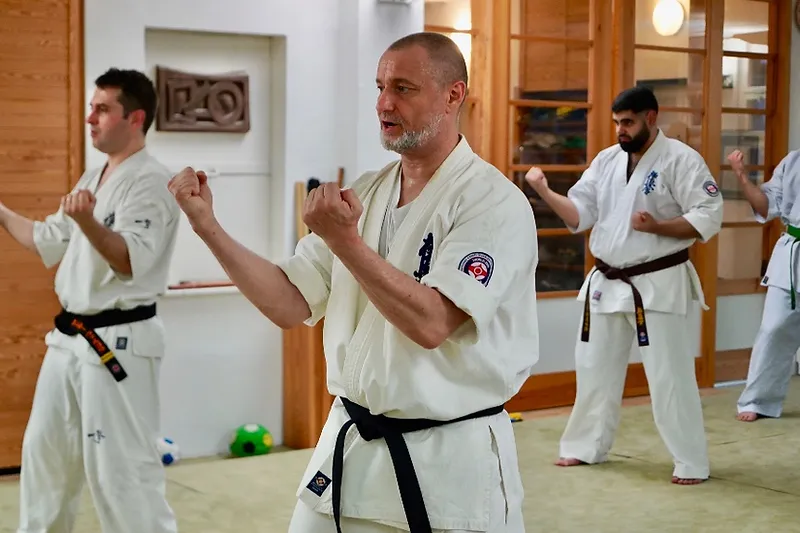
The ultimate truth
Kyokushin Karate is a full-contact karate style founded in 1964 by Masutatsu Oyama founded. The name means the final truth, and that is exactly what it is: no show, no half-measures, but real, tested strength.
In Kyokushin, full-contact fighting is practiced without protective gear, with real power applied to the body. Whoever stands in the dojo, stands honestly. This very directness makes Kyokushin one of the most respected martial arts worldwide.
In Shinzen Dojo Berlin we teach authentic Kyokushin according to Oyama's method, as an official representative of the IKO World Zen-Kyokushin in Berlin. For children, age-appropriate without full contact; for adults, step-by-step until real kumite.
History of Kyokushin
- 1923
Masutatsu Oyama is born in South Korea as Choi Young-Eui; later he adopts the Japanese name.
- 1938
Oyama comes to Japan, studies Shotokan and later Goju-Ryu – the foundations of his own martial art.
- 1953
First public Kyokushin demonstrations; Oyama competes against fighters of other styles and becomes famous.
- 1964
Official founding of the Kyokushin Kaikan in Tokyo. The name Kyokushin – the final truth – is created.
- 1969
First All-Japan Open Karate Championship – the full-contact tournament that makes Kyokushin known worldwide.
- 1975
First World Open Kyokushin Championship in Tokyo – since then, Kyokushin is considered the benchmark for toughness in karate.
- 1994
Sosai Mas Oyama passes away. His students carry Kyokushin forward in numerous countries.

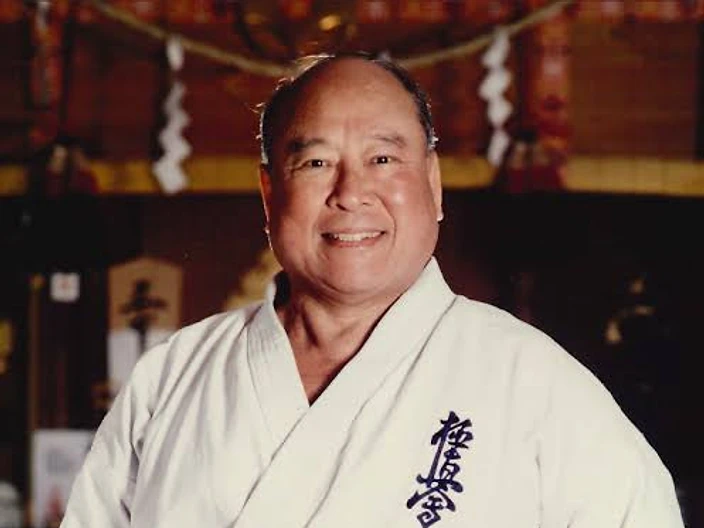
From the spirit of a single man, a worldwide martial art was created. Oyama combined toughness with character and made Kyokushin what it is today: the toughest, most honest, and most consistent form of karate.
Sosai Mas Oyama

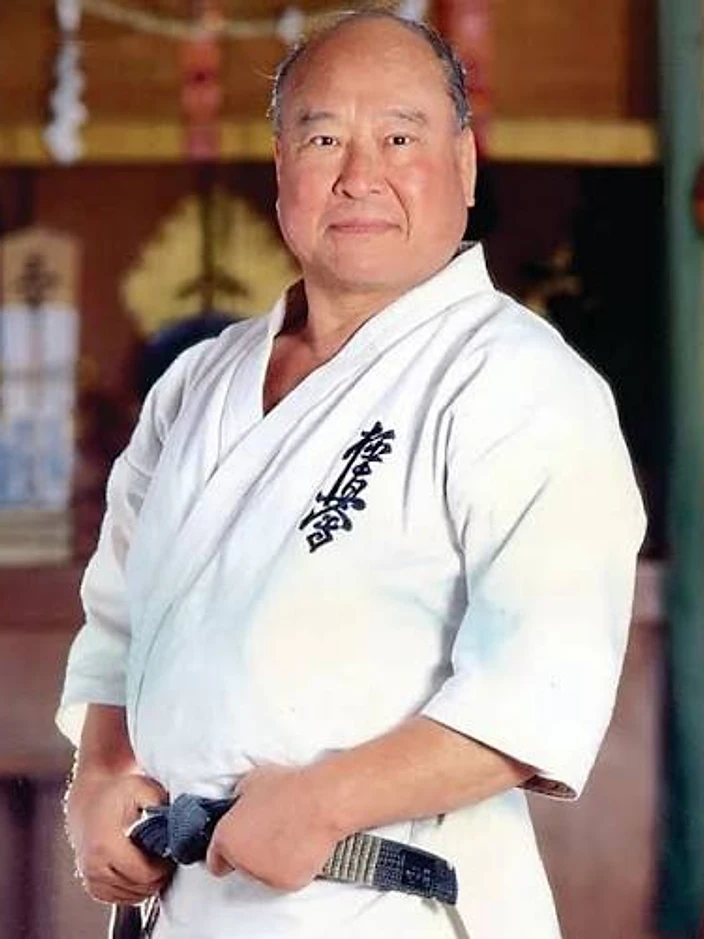
Masutatsu Oyama (大山倍達, 1923–1994) founded Kyokushin and defined it with the claim: true strength is tested in real combat. In the 1950s, he retreated to the mountains for months, trained alone, and subsequently fought his way through dozens of styles and fighters.
He emphasized three things: technical cleanliness, physical hardness and moral character. Without the last, the first is only noise.
„Whoever practises 100 times has understood it. Whoever practises 1000 times can do it. Whoever practises 10 000 times has mastered it."
His legacy lives on in numerous countries. At Shinzen Dojo Berlin, we teach directly in this line.
Read biography and 11 mottosPhilosophy Values
Respect (Rei)
Bowing is a sign of appreciation, to the dojo, to one's partner, to the sensei.
Osu
Combines patience and strength: I accept challenges without complaining.
Discipline
Regular training, punctuality, cleanliness. What applies in the dojo, applies in life.
Humility
Those who become strong learn to be silent. True strength needs no showboating.
Perseverance
Continuous practice over years. Kyokushin does not reward talent, but perseverance.
Honesty
Full contact does not lie. A technique works or it does not; the dojo is honest.
Philosophy & Values
The 7 Dojo Kun, the meaning of OSU, the values, and the legacy of Sosai Mas Oyama – explained in detail.
To the Philosophy pageSchool and DojoAbout Shinzen Dojo Berlin
How these values are lived in the everyday life of a Berlin dojo – team, history and philosophy.
To the DojoDojo-Etiquette
Entering the Dojo
In the dojo, shoes are removed. When entering and leaving, one bows to the mat.
Greeting Ritual
Every training session begins and ends with a communal bow, to the dojo, to the sensei, and to each other.
Punctuality
Those who arrive late wait on the sidelines until the sensei allows them to join the warm-up.
Clean Gi
The karate gi is clean and well-maintained. Fingernails and toenails are short, no jewelry.
Osu instead of Yes
Addressing others and confirmations are made with Osu, a sign of respect and attentiveness.
Hierarchy
The sensei leads, senpai supports, kyudeshi follows. A clear line creates security.
Dojo Kun 道場訓
The Dojo Kun are the seven guiding principles that every Kyokushin karateka affirms – passed down by Sosai Oyama. They are promises to oneself, not formal requirements.
- 1We will train our heart and body and attain a firm, unshakable spirit.
- 2We will fathom the true essence of martial arts, act in the right moment, and sharpen our senses.
- 3We will cultivate the spirit of self-overcoming with humility and inner strength.
- 4We will observe the rules of etiquette, respect our elders, and refrain from violence.
- 5We will follow our spiritual principles and never forget the virtue of humility.
- 6We will increase our wisdom and strength and do what is right in everything we do.
- 7We will fulfill the true path of Kyokushin through the discipline of Karate throughout our entire lives.
„Karate begins with respect and ends with respect."
Training structure
Kihon
Punching, kicking, blocking, and stance techniques. The foundation, cleanly repeated until mastered.
Kata
Fixed technical sequences against imaginary opponents. Training of coordination, breathing, rhythm.
Kumite
Partner and full-contact fighting. Without protective equipment, with controlled intensity, honest and direct.
Every Kyokushin training session follows the same arc: warm-up, Kihon and Ido Geiko, Kata and Bunkai, Kumite, cool-down and bowing. The advanced modules also follow this logic.
Ido Geiko
Basic techniques in forward movement. Standing becomes walking; kihon becomes controlled, dynamic fighting.
Bunkai
The application of kata: every technique is analyzed with a partner. What is hidden in the forms is made understandable here.
Renraku
Technique combinations: punch-kick sequences in flow. Renraku connects kihon to real fighting dynamics.
Tameshiwari
Breaking test (advanced). Proves that a technique has effective power, not show, but consequence.
Kihon
Kihon comprises all individual techniques: punches (Tsuki), strikes (Uchi), blocks (Uke), movements (Geri) and kicks. In Kyokushin, every technique is repeated hundreds of times – from a standing position and in motion.
Stances (Dachi) such as Zenkutsu-dachi or Kiba-dachi give every technique the necessary support. If you cannot stand, you cannot fight – that is why everything begins with Kihon.
- Oizuki (front punch)
- Gyakuzuki (reverse punch)
- Maegeri (front kick)
- Mawashigeri (roundhouse kick)
- Ushirogeri (back kick)
- Yoko-Geri (side kick)
- Age-Uke (rising block)
- Soto-Uke (outside block)
Kata
A Kata is a set fight against several imaginary opponents. It trains coordination, breathing, rhythm and concentration, and together with Kihon and Kumite, forms the heart of Kyokushin. The curriculum ranges from beginner forms Taikyoku to the master kata Suparinpei.
Taikyoku Sono Ichi, Ni, San · Pinan Sono Ichi, Ni, San, Yon, Go
Sanchin · Gekisai Dai Ichi · Gekisai Dai Ni · Tensho · Saifa
Seienchin · Seisan · Seipai · Garyu · Yantsu · Tsuki no Kata
Kanku Dai · Sushiho · Suparinpei
Kumite
In Kyokushin-Kumite, the fight is carried out: full contact to the body, without protective equipment. It is honest, direct and demanding, which is why Kyokushin world championships define a global standard for toughness.
Beginners only start after months of pure Kihon. Sparring levels: Yakusoku-Kumite (agreed), then Jiyu-Kumite (free). Control and clean technique before hardness.

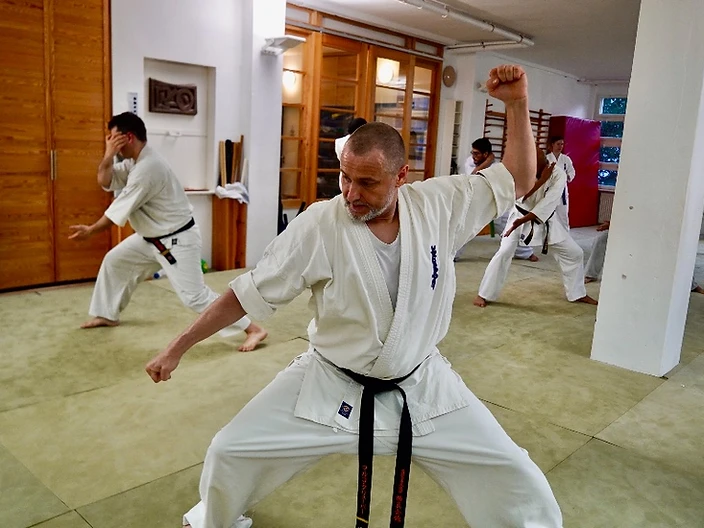
Kumite is not aggression, it is the test of whether what has been practiced works. Whoever stands in Kumite, stands honestly.
Ido Geiko
Ido Geiko is Kihon in motion. Techniques are executed while moving forward and backward; stillness becomes flow. In this way, a clean individual technique becomes one that hits even under pressure in a fight.
Ido Geiko is the bridge between basic training and Kumite: stance remains, timing comes, hardness follows.
Bunkai
Bunkai is the application of a Kata. Every movement of the form is analyzed with a partner: What does it block? What does it strike against? When does it constrain the opponent? This makes visible what has been hidden in a Kata for decades.
For many karateka, Bunkai is the key – the techniques are not just automated, but verstanden. Bunkai connects kihon, kata and kumite into a meaningful martial art.
The belt system
Kyokushin works with Kyu grades (student belts, descending from 10th Kyu to 1st Kyu) and Dan grades (master belts). Every belt shows what you are allowed to practice, not what you have already mastered. Color means permission for the next step.
Kihon, first bow, dojo etiquette, Taikyoku-kata.
Kiba Dachi, Tate-Tsuki, first Pinan-kata, Yakusoku-Kumite.
Uraken, Kansetsu Geri, Sanchin-no-kata, Mawashi Geri.
Shuto techniques, Jodan kicks, Hiji Ate, Pinan Sono Go.
Kumite preparation, complex kata, breaking test, exam preparation.
Beginning of teaching, tournament readiness, role model function.
Gradings Requirements
Gradings take place regularly at Shinzen Dojo. Every grading covers Kihon, Kata, Ido Geiko and Kumite. The examinee shows not only technique, but also attitude; calmness under pressure is part of the grade.
When which level is due is strictly regulated in the grading syllabus – from 10th Kyu to 1st Dan.
Tournament fighting
Kyokushin tournaments are consistent worldwide: fights based on weight classes, full contact to the body, no protective equipment. Youth and beginner categories reduce intensity appropriately for age.
The competition experience behind the Shinzen Dojo goes back to 2009. Today, our karateka gain experience at regional, national and international tournaments – right up to starting at championships in Japan.
Berlin/Brandenburg – first fighting experience
DKO German Championship for advanced students
Bavarian Open, Hanse Cup, All Japan Championship
Age-appropriate kata & kumite competitions, no full contact
Impact Benefits
Self-confidence
Those who know their own strength act differently—in the dojo, at school, at work.
Discipline
The structure of the dojo radiates into everyday life. Regularity becomes a habit.
Fitness
Strength endurance, coordination, flexibility. No machines, just your body.
Mental strength
Enduring pain, carrying on, staying calm. A skill that counts in the ring as much as in life.
Community
True camaraderie is created in the Dojo. Shinzen means friendship.
Health
Full-body training, flexible joints, reduced stress.
Children's training

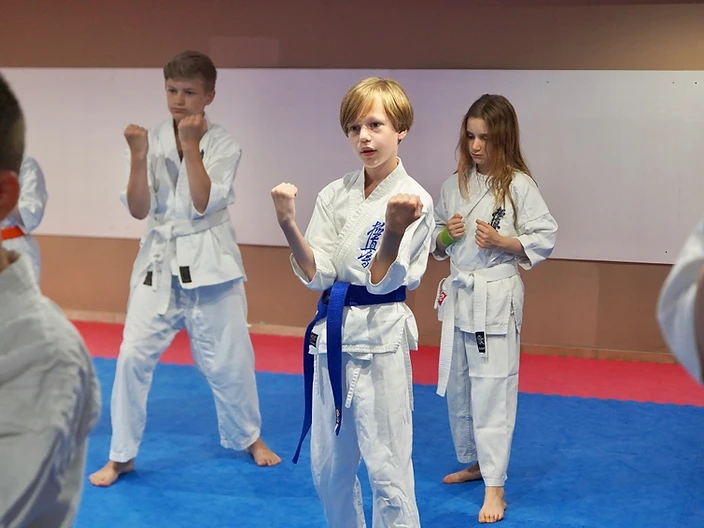
For children, the following explicitly applies: no full contact. The focus is on technique, respect, concentration and basic coordination, taught playfully, appropriately for the age group and in small groups.
Two age groups: 5–8 years (Saturday 09:30) and 9–13 years (Saturday 10:30), both in Berlin-Steglitz. Parents may watch.
- Coordination and mobility
- Respect, politeness, focus
- Self-confidence without aggression
- Small training groups
Adult training
Adults train authentic Kyokushin in stages – from beginner without prior knowledge to full-contact fighter at 1st Kyu. Monday and Thursday 20:30 in Berlin-Schöneberg.
The path is clear: Kihon, Kata, Ido Geiko, Bunkai and Kumite, supplemented by belt gradings and optional tournament training. The training combines technique, conditioning, coordination and controlled partner work.
- Full contact from 1st Kyu, controlled
- Beginners welcome, no prior knowledge necessary
- USC, Wellpass and ClassPass accepted
- Gradings and tournaments optional
Kyokushin explained
Further Article
This page is the center of our Kyokushin knowledge. In the following articles and pages, we delve deeper into individual topics, linked from here, supplemented by each other.
Karate Knowledge Hub
The central knowledge archive, all karate topics structured at a glance.
Open OrganizationsKyokushin organisations
History, lineages, and the current structure of all associations after 1994, neutral and source-based.
Open LexiconKarate glossary A–Z
All Japanese terms translated and explained in detail.
Open ComparisonKarate styles compared
Kyokushin, Shotokan, Goju-Ryu, which style suits you?
Open BiographySosai Masutatsu Oyama
Life, philosophy and legacy of the founder of Kyokushin.
Open CurriculumExamination syllabus & Kyu grades
All techniques and requirements from white belt to black belt.
Open HistoryHistory of karate
600-year timeline, from Okinawa to the Shinzen Dojo Berlin.
Open| Feature | Kyokushin | Other styles / Martial arts |
|---|---|---|
| Contact form in fighting | Full contact to the body, without protective equipment | Point contact or with protective equipment |
| roots | Budo Karate according to Mas Oyama | Sport, point, or competition orientation |
| Kata | Fixed component of every level | Often neglected or purely sporting |
| Gradings | Clearly structured Kyu and Dan grades | Partly without a grading system |
| Philosophy | Respect, Osu, humility as core | Frequently purely performance-oriented |
| Tournaments | Full-contact kumite to the body | Matches with protection or stops shortly after contact |
Kyokushin erleben.
No prior knowledge necessary. The trial session is free and non-binding for children, teenagers and adults.
Book a trial classDeeper into Kyokushin
Deepen your Kyokushin knowledge with selected posts on technique, philosophy and tradition, directly to your inbox.
No spam · Unsubscribe anytime · Consent can be revoked at any time
Read more


Staying fit in winter: Karate, nutrition and healthy training routines
Staying fit through the winter with Kyokushin Karate: At the Shinzen Dojo Berlin, regular exercise, a good warm-up and sufficient recovery go hand in hand. Read why dry clothes after training, a clean karate gi and well-maintained equipment are important. We also provide practical tips on broth, herbal tea with honey and a balanced diet. We explain when Vitamin C, Vitamin D or magnesium might be useful and why you should rather take a break from training if you have a cold.
Read more
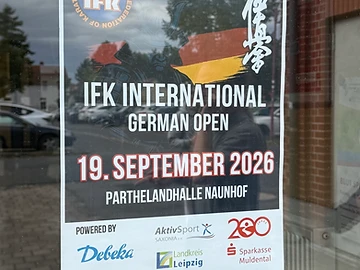
IFK German Open 2026: A first competition that remains in memory Black belt
A white belt, his first tournament and straight away an experienced black belt as an opponent: For Victory Ogbonna, the IFK German Open 2026 became a special experience. In Naunhof, the 27-year-old from Shinzen Dojo Berlin competed for the first time in the Kumite +90 kg category. After regular fight time and extra time, he lost by Waza-ari, but showed fighting spirit and got back up after a hard head strike. A first competition, an important experience – and definitely not the last.
Read more

First World Zen-Kyokushin German Summer Camp 2026 at Werbellinsee
Three days of Kyokushin Karate, intensive training sessions, grading and true community: From August 28 to 30, 2026, the first World Zen-Kyokushin German Summer Camp took place at Werbellinsee. Karateka of different generations and grades trained Kihon, combinations, Kata and Kumite together. A review of a special weekend full of training, challenges and shared experiences.
Read more