Dojo- Etiquette
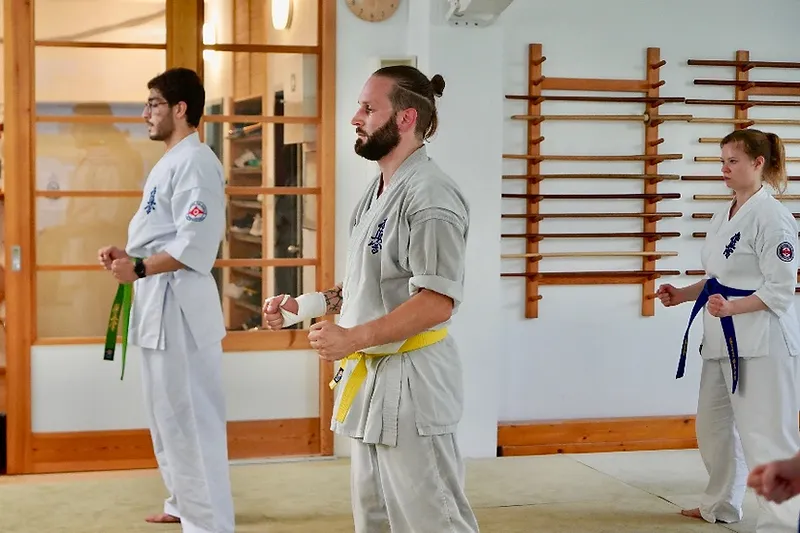
Conduct in the Dojo
Dojo etiquette is not mere formality, but part of the path. In Japanese, it is called Reishiki (礼式), the form of respect. It encompasses the greeting ceremony, rules of conduct, and the rituals that frame every training session.
Etiquette sets the dojo apart from the outside world. Anyone who enters the room leaves their external roles at the door: lawyer or student, manager or apprentice—in the dojo, only the belt counts. This clarity creates the space for focused practice.
In Kyokushin a distinct imprint is added: Osu as a central word, the Dojo Kun as a shared vow, the Senpai-Kōhai hierarchy. This page explains the etiquette quellenbasiert based on official Kyokushin sources (masutatsuoyama.com) and traditional dojo protocols.
Historical roots
Dojo etiquette is not invented; it has grown. It is rooted in Japanese Bushido traditionBushido, the ethics of the samurai, and was passed on to modern karate via Okinawa and the mainland.
Bushido tradition
Dojo etiquette is rooted in Japanese Bushido (way of the warrior). The seven virtues of the samurai (Gi, Yu, Jin, Rei, Makoto, Meiyo, Chugi) are the ethical framework within which Karate-Dō also stands.
Rei as the core
Rei (礼) means respect, courtesy, bowing. Gichin Funakoshi, founder of Shotokan, formulated as the first of his 20 guiding principles (Nijū Kun): 'Karate begins and ends with courtesy.' This applies to every karate style.
Shintō roots
The bow to the Shōmen has roots in the Shintō religion. In a traditional dojo, the Kamiza (seat of honor), Kamidana (shrine), and Dojo Kun are located at the front, which thus becomes a sacred area. The bow is a Japanese custom for respect, modesty, and humility.
Origin of Osu
The shout 'Osu' spread via Japanese university karate clubs on the mainland and was adopted by Kyokushin. On Okinawa, the home of karate, more polite expressions such as 'Onegai shimasu' and 'Arigatō gozaimashita' were traditionally used.
„Karate begins and ends with courtesy."
Reishiki Procedure
The formal greeting ceremony (Reishiki) frames every training session. It follows a set sequence that is the same in traditional dojos worldwide. The order according to Japanese protocol:
- 1整列Seiretsu
Line Up
On the command, all karateka line up in rows according to rank. The highest rank is at the front left (farthest from the door), with lower belts following to the right. This arrangement follows Japanese tradition: the highest-ranking person sits in the safest place.
- 2正座Seiza
Formal kneeling position
The Sensei kneels first, followed by the students in order of rank. Seiza is the traditional Japanese sitting posture on the heels, back straight, hands on the thighs.
- 3黙想Mokusō
Meditation
On the command, everyone closes their eyes. Mokusō is used for mental preparation: the mind becomes empty (Mushin), and daily life and external roles are left outside the door.
- 4黙想止Mokusō Yame
Meditation ended
On the command, everyone opens their eyes. Meditation ends, and attention is directed toward the training.
- 5正面に礼Shōmen ni rei
Bow to the front
Bow to the Shōmen, the front of the dojo. This is where the Kamiza (seat of honor) with the Kamidana (Shintō shrine) and Dojo Kun are traditionally located. The bow honors the founders and tradition. Rooted in the Shintō religion.
- 6先生に礼Sensei ni rei
Bow to the teacher
Bow to the Sensei (or Senpai, if the Sensei is absent). Accompanied by 'Onegai shimasu' (I request your instruction). Recognition of the teacher and the lineage of transmission.
- 7お互いに礼Otagai ni rei
Bow to each other
Students bow to one another. Respect for every training partner, regardless of rank. Without each other, there is no training.
General Dojo rules
Beyond the formal ceremony, there are rules of conduct that govern life within the dojo. They originate from Sosai Mas Oyama and are part of the official Kyokushin dojo etiquette.
Entering and leaving
When entering or leaving the dojo, stand in the doorway, face the front, bow, and say 'Osu'. This shows respect for the dojo and the people within it. Shoes are removed.
Lateness
Those who are late kneel in Seiza at the edge, facing away from the training. When the Sensei gives permission, stand up, bow, say 'Osu' and 'Shitsurei shimasu' (excuse the disturbance), then quickly join the back of the line.
Ranking
The lineup is based on graduation. Do not step out of line without permission and never walk between the Sensei and the class. Walk behind your own row to the side.
Forms of address and titles
In the dojo, address teachers and seniors by their titles: Senpai (先輩), Sensei (先生), Shihan (師範). Confirm with a loud 'Osu' when they speak to you, not a casual 'Yes'.
Clean Gi
The karate dogi (Gi) must be clean and well-maintained. The belt (Obi) is traditionally never washed, only aired out. Symbolically, it contains the spirit of hard training. Fingernails and toenails must be short and clean.
Behavior during training
Training is serious. No laughing, chatting, or disturbing others. Respond quickly to commands, do not dawdle. When waiting, stand in Fudo Dachi (ready stance), do not lean or slouch.
Kumite only on instruction
Fighting (Kumite) begins only on the express instruction of the Sensei. No one should practice techniques with a partner independently without it being announced.
Shared responsibility
Keeping the dojo clean, tidy, and safe is everyone's task. No one leaves the room before mats and materials are cleared. No jewelry or watches during training.
Etiquette in Kyokushin
In Kyokushin, there is an additional characteristic that goes beyond general etiquette. It is shaped by Osu as the central word, the Dojo Kun as a joint oath, and the Senpai-Kōhai hierarchy.
Osu instead of Yes
Osu is the central affirmation in Kyokushin. The term combines Oshi (to push) and Shinobu (to endure) into 'oshi shinobu': to persevere while being pushed. Osu means patience, determination, appreciation, respect, and endurance. It replaces the casual 'Yes' in the dojo.
The Dojo Kun
At the end of every training session, all karateka recite the Dojo Kun while in Seiza—the seven guiding principles of Sosai Mas Oyama and Eiji Yoshikawa. The highest-ranking person calls out each line, and the class repeats it. 'Hitotsu' (一) before each line means: no line is more important than another.
Ready stance
While waiting for the next command, stand in Fudo Dachi, not relaxed or leaning. The body remains ready, the mind alert. Discipline is shown in standing, not just in fighting.
Senpai and Kōhai
The Senpai-Kōhai relationship shapes the Kyokushin dojo. The Senpai (senior) leads and protects, the Kōhai (junior) follows and learns. This hierarchy creates safety, not oppression.
The Dojo Kun by Mas Oyama
The Dojo Kun (Dojo Kun) are the seven guiding principles that Sosai Mas Oyama composed with the writer Eiji Yoshikawa, the author of 'Musashi'. They are recited at the end of every training session in Seiza: The highest-ranking person calls out each line, and the class repeats it. 'Hitotsu' (一) before every line means: No line stands above the other; all are equally important.
- 1
一、吾々は心身を錬磨し 確固不抜の心技を極めること
We will train our hearts and bodies to achieve a firm, unshakable spirit.
- 2
一、吾々は武の真髄を極め 機に発し感に敏なること
We will pursue the true meaning of the martial arts path so that, in time, our senses may become alert.
- 3
一、吾々は質実剛健を以て 克己の精神を涵養すること
With true vigor, we will strive to cultivate a spirit of self-denial.
- 4
一、吾々は礼節を重んじ 長上を敬し粗暴の振る舞いを慎むこと
We will observe the rules of courtesy, respect our superiors, and refrain from violence.
- 5
一、吾々は神仏を尊び 謙譲の美徳を忘れざること
We will follow our religious principles and never forget the true virtue of humility.
- 6
一、吾々は智性と体力とを向上させ 事に臨んで過たざること
We will look up to wisdom and strength and not seek other desires.
- 7
一、吾々は生涯の修行を空手の道に通じ 極真の道を全うすること
All our lives, through the discipline of karate, we will seek to fulfill the true meaning of the Kyokushin Way.
„The path of martial arts begins and ends with courtesy. Therefore, be properly and sincerely courteous at all times."
In Shinzen Dojo


In Shinzen Dojo Berlin we maintain traditional etiquette as part of our training. Every session begins and ends with the Reishiki ceremony, and the Dojo Kun is recited together.
For Children etiquette is introduced age-appropriately: bowing, punctuality, and respect are the focus from the start. The formal ceremony is developed step-by-step. For Adults the full tradition applies, as maintained in Kyokushin dojos worldwide.
- Reishiki at the beginning and end of every session
- Dojo Kun recited in Seiza
- Osu as the central word in the dojo
- Senpai-Kōhai hierarchy based on rank
- Clean Gi, short nails, no jewelry
Dojo etiquette explained
Further Topics
What is Kyokushin?
The complete guide to etiquette, Dojo Kun, and training structure.
Open PhilosophyPhilosophy & Values
The 7 Dojo Kun, Osu, and the roots of karate explained in detail.
Open LexiconKarate glossary A–Z
All Japanese terms such as Rei, Seiza, Mokusō translated.
Open BiographySosai Mas Oyama
Life and legacy of the founder who wrote the Dojo Kun.
Open HistoryHistory of karate
600-year timeline from Okinawa to modern Kyokushin.
Open Knowledge HubKarate Knowledge Hub
The central knowledge archive for all karate topics.
OpenSources & References
All content on this page is based on external primary sources, not on AI-generated knowledge or internal dojo texts. Quotes are original translations of the respective sources.
- masutatsuoyama.com — Kyokushin Dojo Kun (official)
- masutatsuoyama.com — Dojo Etiquette (14 rules)
- masutatsuoyama.com — The Meaning of Osu
- masutatsuoyama.com — The Eleven Mottoes (Niju Kun)
- GWU JKA — Dojo Protocol (Shotokan)
- Eastside Kyokushin — Dojo Oath (EN/JP)
- English Shotokan Academy — Funakoshi 20 Precepts
Get to know Kyokushin in training
Anyone who wants to get to know Kyokushin not just by reading about it but in practice can visit the Shinzen Dojo Berlin training sessions. Adults train in Berlin-Schöneberg, children and teenagers in Berlin-Steglitz.