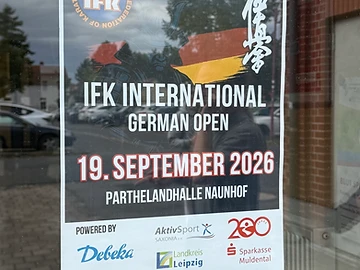
First World Zen-Kyokushin German Summer Camp 2026 at Werbellinsee
Drei Tage Kyokushin Karate, intensive Trainingseinheiten, Prüfungen und viele gemeinsame Momente: Vom 28. bis 30. August 2026 fand am Werbellinsee das erste World Zen-Kyokushin German Summer Camp statt – ausgerichtet vom Shinzen Dojo Berlin.
A week has now passed. The dogi are washed, the certificates handed over and regular training operations have long since resumed. Time to look back on a weekend that was something special for our dojo and everyone involved.
Karateka of different grades and generations came together at Werbellinsee.
Children, teenagers and adults, beginners and experienced karateka trained together, exchanged ideas and faced new challenges for three days.


„Ein Sommerlager endet nach drei Tagen. Das, was wir dort lernen und gemeinsam erleben, nehmen wir mit zurück ins Dojo. – Sensei Son, Shinzen Dojo Berlin
Friday: Arrival at Werbellinsee
On Friday afternoon, our first joint summer camp at Werbellinsee began.
After arriving and settling into the rooms, participants from different dojos and training groups gradually met up. Some already knew each other from training, workshops or tournaments, others met for the first time this weekend.
In the evening, everyone finally came together in their dogi.
The Opening training led by Sensei Son was kept deliberately relaxed. After the journey, the initial focus was on starting the weekend together, getting the body moving and welcoming all participants.


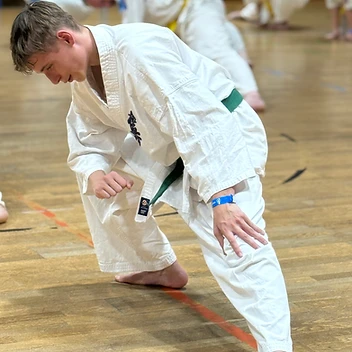


The first evening: Time for encounters
After training, the first day was not yet over.
A summer camp, after all, thrives on more than just the hours spent in the dogi. In the evening, there was time to sit together and chat outside the training area.
Also Shihan Jaroslaw Remus and Senpai Paul Kniep were there. Over a drink together, the first evening was able to wind down in a relaxed atmosphere.


For us, such conversations are part and parcel of a summer camp. In everyday training, there is often little time for this. Here, experienced karateka, instructors and students could simply sit together, talk and get to know each other better.
Saturday, 6:30 AM: Who wants to go running?
Saturday began earlier for some participants than for others.
6:30 AM. Running shoes on.
Morning jogging was optional. No one had to participate – but a small group did not want to miss the opportunity and started the day together.
Even before the actual karate program had begun, the first few kilometres had already been covered.
Afterwards, we returned to the accommodation and had breakfast together.
And then a long day of training began.


Basics, combinations and Kumite with Senpai Paul Kniep
The first major karate session of Saturday was led by Senpai Paul Kniep from Leipzig.


His session focused on something that, regardless of grade, never loses its importance: the basics.
From the basics, various combinations developed and finally the transition to Kumite. The aim was not just to execute techniques individually, but to combine them and apply them while moving.
For less experienced participants, the session offered the opportunity to experience familiar techniques in new contexts. Advanced students, on the other hand, were able to consciously focus again on details that sometimes seem taken for granted with increasing experience.
Because even in Kumite, the rule applies:
- Good karate needs good basics.


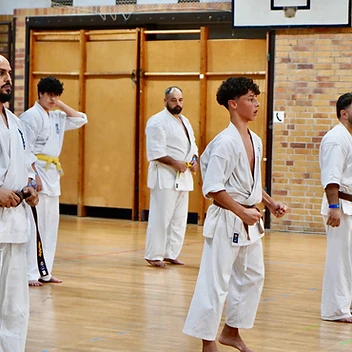


A quick break: Outdoor training with Sensei Son
After Senpai Paul's session, we went back outside once more.
Sensei Son Sensei Son took over a short outdoor session before the first major training block of the day ended.
Following the more intensive content in the morning, this session was deliberately kept compact.
At the same time, the setting at Werbellinsee offered the opportunity to leave the normal indoor environment for a moment and train together under the open sky.


After that, it was time for the lunch break.
And it was necessary.
Free time is part of the summer camp experience.
The morning training was followed by a longer period of free time.
Especially at a summer camp with children, teenagers, and adults, it was important to us not to fill every minute with a scheduled activity. Training requires exertion – but just as much recovery.
Participants were able to enjoy the surroundings, withdraw, spend time together, or simply prepare for the upcoming sessions.
Because in the afternoon, two special training blocks were still waiting.
Shihan Jaroslaw Remus: Kihon, Ido, and partner work under the open sky
In the afternoon, Shihan Jaroslaw Remus from Poland took over the next major outdoor session.


The focus was on Kihon, movement patterns, and Ido combinations. However, it did not stop at simply performing techniques together.
Shihan Remus supplemented the content with partner exercises, thereby demonstrating the connection between clean basic technique, movement, and practical application.
Distance, body position, and the correct mechanics of a technique can be practiced alone. However, with a partner, the same movement suddenly gains a different context.
It was precisely this connection that made the session particularly interesting.
And the large training group in the middle of the greenery also created an atmosphere that differed significantly from everyday Dojo life.


“Kihon is not just about repeating a technique. Only when we understand how to move our body does the technique gain its meaning.”
Special Kumite with Pawel Stasinski
After that, the focus shifted significantly.
Pawel Stasinski took over a special Kumite session and brought new momentum to the training.


After much technical work, the focus was now more on movement, distance, timing, reaction, and practical implementation in a fight.
The session challenged the participants in a different way and was one of the most intensive training moments of the weekend.
Different training partners also meant different tasks. Size, weight, reach, tempo, and fighting style constantly change a situation.
That is precisely why joint training with Karateka outside of one's own familiar group is so valuable.
You have to adapt.
You have to observe.
And you have to learn.


Saturday evening: Now it got serious
After a short break and dinner, another important part of the summer camp began for some of the participants:
the belt examination.
On Saturday evening, the first item Kihon on the agenda was the examination.
The examinees had to show what they had worked on over the past few months. Technique, posture, concentration, and endurance all played a role.
But a summer camp cannot always be planned to the minute.
The examination took longer than expected and the evening was already quite advanced. Therefore, it was decided to break off at this point and continue with Kata and Kumite on Sunday.
Because the communal barbecue was already waiting outside.
A barbecue instead of a training schedule
After a long Saturday with jogging, several karate sessions, and the first part of the examination, it was time to let the day wind down together.
At the barbecue, it was no longer about techniques or gradings.
It was simply about being together.
Trainers, students, children, teenagers, and adults had all had a long day behind them. Now it was time to eat, talk, and laugh.
Unfortunately, there are hardly any pictures of this either.
But perhaps that is a good sign.


Sunday: Kata, Kumite – and giving everything once more
On Sunday morning, after breakfast, we returned to the training area.
For the examinees, the day began with Kata.
After Kihon the previous evening, flow, technique, posture, concentration, and expression now had to be shown in the respective forms.
This was followed by the most physically and mentally demanding part:
Kumite.
Round by round, the training partners changed.
As time went on, arms and legs grew heavier. Maintaining concentration and technique under exertion became increasingly difficult.
However, that is precisely an essential part of a Kyokushin examination.
Not just showing what works when you are fresh.
But continuing to work when it gets exhausting.


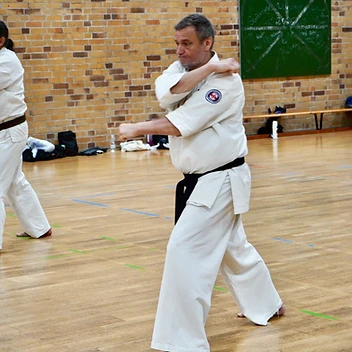

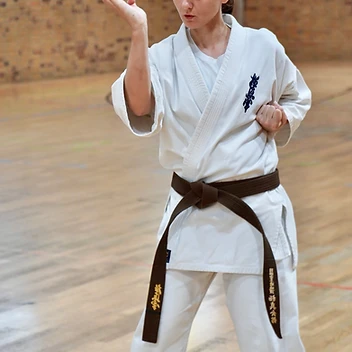


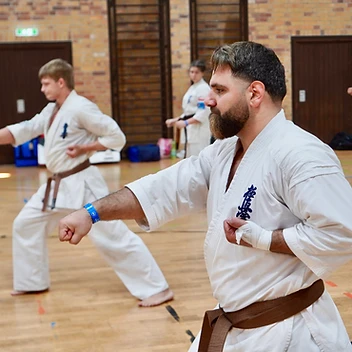


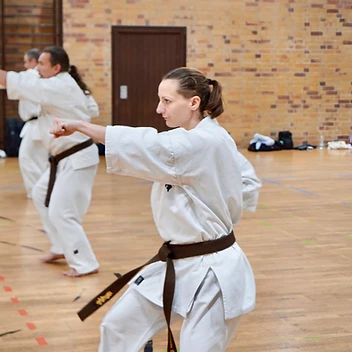


An examination is no guarantee of a new belt
A belt examination at Shinzen Dojo Berlin is not a formality.
Therefore, participating in the summer camp did not automatically mean a new grading.
Some decisions were close. For some examinees, clear recommendations for further technical development were given. And not everyone was able to fully meet the requirements this time.
That, too, is part of a serious examination.
Because a grading only has meaning if the requirements behind it also have meaning.
We congratulate all those who successfully passed their examination all the more.
And just as importantly:
Respect to everyone who stepped up and faced the examination.
Those who did not reach their goal this time are not being shown a dead end, but rather a task for further training.
The belt is not the goal. What is decisive is the development necessary to live up to it.
Special moments for Julia and Marco
Among the many personal stories of this weekend, there were also special moments that we would like to capture.
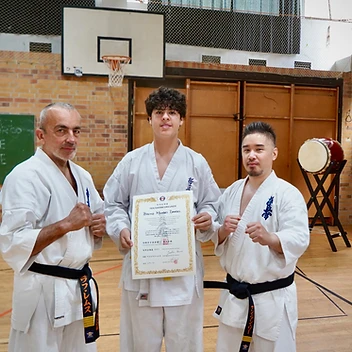
For For Julia and Marco, this weekend marked an important step on their personal Kyokushin journey.
Such gradings are not created in a single weekend. Behind them lie months and years of training, numerous Kihon sessions, Kata, Kumite, mistakes, corrections, and the decision to always return to the Dojo.
A new belt therefore does not mean that the work is finished.
With a higher grading, expectations of one's own karate increase, as does the responsibility towards those who are still at the beginning of their journey.
We sincerely congratulate both of them on this special milestone.


The last group photo
Eventually, even the most intensive training weekend comes to an end.
After the final Kumite rounds, everyone came together once more.
Tired faces, heavy legs – and yet enough energy for the final group photo.


This picture perhaps shows best what remains of this weekend.
Not individual training sessions.
Not a precise hourly schedule.
Not the number of Kumite rounds.
But people who trained together and spent a weekend with each other.
More than Kihon, Kata, and Kumite
Of course, the first World Zen-Kyokushin German Summer Camp was a karate summer camp.
- We trained Kihon.
- We practiced combinations.
- We ran Kata.
- We did Kumite.
- And we conducted examinations.
But a summer camp also shows a different side of karate.
You get up together in the morning. Some go for a run at 6:30 AM. You meet at breakfast. You train together, take breaks together, and sit together in the evening.
A younger student suddenly trains next to an experienced karateka.
People from different Dojos get to know each other. Trainers have time for conversations outside of their sessions.
For one weekend, individual participants turn into a community.
No training schedule can fully capture that.
Thank you
A weekend like this does not start at Friday's check-in.
- Weeks beforehand, rooms were planned,
- training content was coordinated,
- participant information was sent out,
- dietary requirements were taken into account,
- examinations were prepared,
- certificates were created,
- equipment was organized, and many small questions were clarified.
Our special thanks go to Shihan Jaroslaw Remus, Senpai Paul Kniep and Pawel Stasinski for their training sessions, their time, and the inspiration they shared with our group.
Thanks also to all other helpers and supporters who lent a hand before and during the summer camp.
And naturally:
Thanks to our participants, parents and families.
Children, teenagers and adults trained together. Parents accompanied and supported. Training partners carried each other through strenuous sessions and examination rounds.
Without these people, the idea of a summer camp would not have become a shared experience.


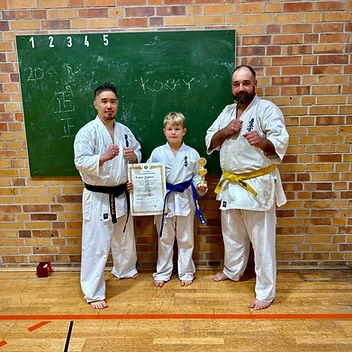




On Monday evening we were back in the dojo
Perhaps one small thing says the most about what we take away from the weekend:
Training was already taking place again in Berlin on Monday.


Just one day after the summer camp.
And techniques and exercises from Lake Werbellinsee already found their way into our regular training.
Because a summer camp is not an end.
A passed examination is not an end.
And a new grading is also not an end.
It continues. Continues. Always continues.
OSU!
Kyokushin Karate in Berlin kennenlernen
The Shinzen Dojo Berlin bietet Kyokushin Karate for children, Jugendliche und Erwachsene. Bei uns trainieren Anfänger gemeinsam mit Karateka, die bereits seit vielen Jahren diesen Weg gehen.
Our training combines Kihon, Kata and Kumite with physical fitness, discipline, respect and a community in which everyone can make their own progress.
Anyone who wants to get to know Kyokushin themselves does not have to wait until the next summer camp.
Train with us and experience Kyokushin Karate in Berlin for yourself.
Further information on training times and how to join can be found at www.shinzen-dojo.de.
World Zen-Kyokushin German Summer Camp 2026
Date: 28–30 August 2026
Location: Werbellinsee, Brandenburg
Organizer: Shinzen Dojo Berlin
Karate: Kyokushin Karate
Training contents: Kihon, combinations, kata, Ido Geiko, partner training, kumite and belt examinations