Philosophy & Values

What does Kyokushin mean?
Kyokushin (極真), two characters, one worldview. The name is not a coincidence, but a program: it describes the standard by which every Karateka is measured. Whoever stands in the dojo, stands in the ultimate truth.
Kyoku means the last, the ultimate, the absolute limit. It stands for the ambition to go beyond the ordinary – not halfway, not almost, but completely. A technique that is only 90% effective is not a technique in Kyokushin.
Shin means truth, sincerity, the essential. No show, no illusion. What happens in the dojo is real – the fight does not lie, the pain does not lie, the respect does not lie.
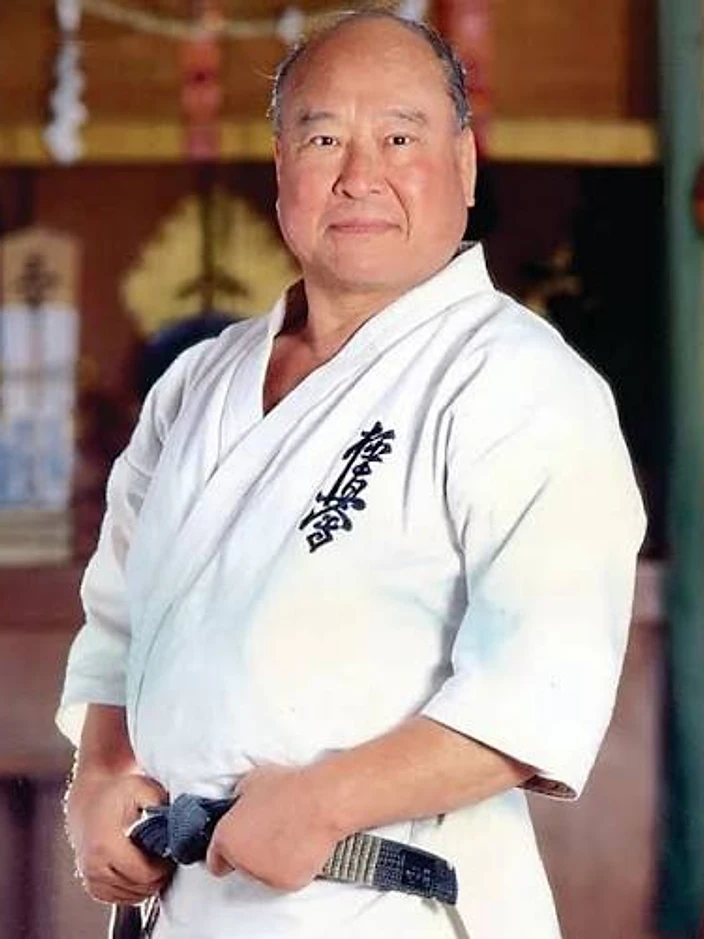
Sosai Mas Oyama
Masutatsu Oyama (1923–1994) founded Kyokushin in 1964 in Tokyo. His philosophy is expressed in the Dojo Kun, the seven guiding principles that connect every Kyokushin dojo to this day.
Read biography„Whoever practices 100 times has understood it. Whoever practices 1,000 times can do it. Whoever practices 10,000 times has mastered it."

The 7 Dojo Kun
The Dojo Kun are the seven guiding principles that every Kyokushin karateka affirms – passed down by Sosai Mas Oyama. They are not formal requirements, but a promise to oneself. Each sentence begins with “一" (Hitotsu) – “the first" – because every sentence is equally important.
The first sentence connects body and mind into a single unit. Karate does not begin with the fist, but with the posture – he who cannot stand in a stance cannot fight in combat. Unshakable means: staying calm even under pressure, getting back up even after defeats.
Technique alone is just movement. Only when you understand why a technique works – when, against what, with what intention – does sport become martial art. Ki ni hasshi, kan ni bin naru (機に発し感に敏なる) means: reacting at the right moment with alert senses. This is the essence of Budo.
Shitsujitsu gōken (質実剛健) – simple, sincere, strong. Those who become strong learn to remain silent. True strength requires no posing, no boasting. Kokki (克己) – self-overcoming – is the highest value: to defeat oneself, not the opponent. He who masters himself is free.
Rei (礼) – courtesy – is not form, but attitude. He who bows acknowledges: before the dojo, before the partner, before the path. Chōjō o keishi (長上を敬し) means to respect the elders and the more experienced – they walk the path before us. Non-violence in everyday life is the flip side of strength in combat.
Shinbutsu (神仏) – gods and Buddha – stands for respect for something greater. You do not have to be religious, but you should be humble. Kenjō (謙譲) – humility – is the virtue that sustains all others. Whoever is strong and remains humble is truly strong.
Chisei (智性) – intellect – and tairyoku (体力) – physical strength – must grow together. Karate trains both. Koto ni nozonde ayamatazaru koto (事に臨んで過たざる) means: when it comes down to it, not to err. This requires preparation – in the dojo as well as in life.
The last sentence points beyond the dojo. Shōgai no shūgyō (生涯の修行) – lifelong practice. Karate does not end with the final training session, but with the final breath. What you learn in the dojo – respect, discipline, endurance – should shape your whole life. This is the deepest meaning of Kyokushin.
„Karate begins with respect and ends with respect."
The meaning of OSU
Osu is more than a word. It is a greeting, a confirmation, and a way of life all in one. A single word that carries patience and strength, respect and endurance within it.
The first syllable 押 (Oshi) means "push" – to accept pressure, to keep moving forward, not to retreat. The second syllable 忍 (Shin/Nin) means "endure" – to bear pain, fatigue, and frustration without complaining.
Together: "Push forward and endure." Whoever says Osu does not just say "yes" – they say: "I accept the challenge, no matter how difficult."
"Osu no seishin – the spirit of Osu – is the foundation of Kyokushin."
Masutatsu OyamaThe values of Kyokushin
Six values carry Kyokushin. They are not abstract, but concrete, palpable in every training session, in every bow, in every fight. Whoever lives them carries Kyokushin beyond the dojo into everyday life.
Respect
ReiBowing is recognition – towards the dojo, towards the partner, towards the Sensei. Respect is not submission, but an attitude: I see you, I honor you, I learn from you.
Discipline
KiritsuRegular training, punctuality, cleanliness. What applies in the dojo, applies in life. Discipline is not a restriction, but freedom – those who have self-control have choice.
Humility
KenkyoThose who become strong learn to be silent. True strength needs no posturing. Humility means: remaining a student, never believing one has reached the end.
Courage
YūkiCourage is not the absence of fear, but the decision to act regardless. In full contact as in life: standing tall when it matters.
Perseverance
NintaiKyokushin does not reward talent, but perseverance. Continued practice over years. Those who persevere win – not always the fight, but always themselves.
Community
KyōdōShinzen means friendship. Genuine camaraderie is formed in the dojo – you train together, suffer together, grow together. No one goes alone.
Values in everyday life
What is started in the dojo does not end at the door. Respect, discipline, humility, courage, perseverance, and community are not dojo values, they are life values. This is where their effects are shown.
At Work
Discipline shows in reliability. Respect in dealings with colleagues. Courage to have difficult conversations. Perseverance on projects that take months. Those who have learned at the dojo to remain calm under pressure radiate this in the office.
At School
Concentration instead of distraction. Humility to admit and correct mistakes. Perseverance in learning, even when it is difficult. Respect for teachers and fellow students. Karate kids stand out – not through volume, but through focus.
In Daily Life
Punctuality, politeness, cleanliness. The little things that make the difference. Those who have learned to keep their Gi clean also keep their life in order. Discipline becomes a habit, habit becomes character.
In Private Life
Patience with yourself and others. Courage to recognize and set your own boundaries. Community instead of isolation. Those who have learned trust in the dojo also trust in life – and that is the foundation of genuine relationships.
The quote by Sosai Oyama
"Keep your head bowed but aim high, keep your mouth shut, your heart and mind open and be devoted to the welfare of others."
“Keep your head bowed, but aim high. Keep your mouth shut, your heart and mind open, and be devoted to the welfare of others.”
"Keep your head bowed but aim high"
Humility and ambition are not a contradiction. Those who bow their heads acknowledge that they have not yet reached their goal. Those who nevertheless aim high are not satisfied with mediocrity. Both together: humble in demeanor, relentless in aspiration.
"Keep your mouth shut"
Talking is easy. Action counts. Whoever promises much and keeps little loses respect. In the dojo as in life: let your actions speak, not your words. Silence is strength, not weakness.
"Your heart and your mind open"
Openness means: remaining ready to learn, setting aside prejudices, allowing for the new. Whoever closes their mind stops growing. Whoever closes their heart stops feeling. Both are essential in Kyokushin.
"Be devoted to the welfare of others"
The deepest sentence. Strength used only for oneself is not strength. What you learn in the dojo – respect, discipline, endurance – should be carried into the world. That is the meaning of Kyokushin.
Philosophical timeline
- 1923
Masutatsu Oyama is born. He later coins the thought: Karate begins with respect and ends with respect.
- 1953
Oyama competes against fighters of all styles and proves: true strength is not style, but attitude.
- 1964
Founding of the Kyokushin Kaikan. The name 極真, the ultimate truth, becomes a philosophical program.
- 1965
Oyama formulates the Dojo Kun, the guiding principles that still connect every Kyokushin dojo worldwide today.
- 1994
Sosai Oyama passes away. His ideas continue to shape Kyokushin internationally to this day, carried by every bow.
- 2019
Sensei Anh Son Le founds the Shinzen Dojo Berlin. Shinzen (親善) means friendship. One word, one attitude.

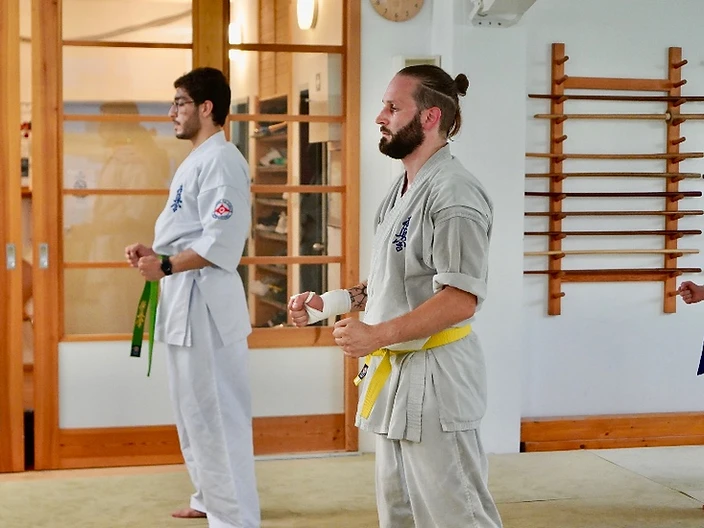
From Oyama's mountain solitude to the Shinzen Dojo Berlin: the philosophy of Kyokushin has endured for over a century, not because it is old, but because it is true. Every generation carries it forward. We carry it in Berlin.
Philosophy explained
Further Article
This page is the philosophical center of our Kyokushin knowledge. The following pages delve into individual topics, linked from here, supplemented throughout.
What is Kyokushin?
The central guideline: history, training, belt system, examinations, and tournaments.
Open BiographySosai Mas Oyama
Life, 11 mottos, and legacy of the founder of Kyokushin.
Open The DojoAbout Shinzen Dojo
How these values are lived in the everyday life of a Berlin dojo.
Open For childrenChildren's Karate in Berlin
Values from the start – respect and discipline for ages 5–13.
Open For adultsAdult training
Full-contact Karate as a school of life – from age 18, all levels.
Open CurriculumExamination regulations
The path from white to black belt – measurable and structured.
OpenValues erleben.
Reading about philosophy is good. Feeling it is better. Come for a trial training, free, without obligation, open to everyone.
Book a trial classRead more


Staying fit in winter: Karate, nutrition and healthy training routines
Staying fit through the winter with Kyokushin Karate: At the Shinzen Dojo Berlin, regular exercise, a good warm-up and sufficient recovery go hand in hand. Read why dry clothes after training, a clean karate gi and well-maintained equipment are important. We also provide practical tips on broth, herbal tea with honey and a balanced diet. We explain when Vitamin C, Vitamin D or magnesium might be useful and why you should rather take a break from training if you have a cold.
Read more
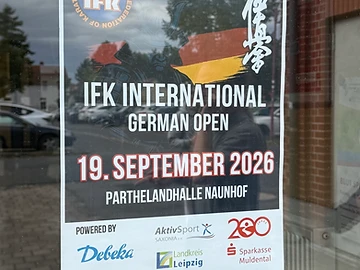
IFK German Open 2026: A first competition that remains in memory Black belt
A white belt, his first tournament and straight away an experienced black belt as an opponent: For Victory Ogbonna, the IFK German Open 2026 became a special experience. In Naunhof, the 27-year-old from Shinzen Dojo Berlin competed for the first time in the Kumite +90 kg category. After regular fight time and extra time, he lost by Waza-ari, but showed fighting spirit and got back up after a hard head strike. A first competition, an important experience – and definitely not the last.
Read more

First World Zen-Kyokushin German Summer Camp 2026 at Werbellinsee
Three days of Kyokushin Karate, intensive training sessions, grading and true community: From August 28 to 30, 2026, the first World Zen-Kyokushin German Summer Camp took place at Werbellinsee. Karateka of different generations and grades trained Kihon, combinations, Kata and Kumite together. A review of a special weekend full of training, challenges and shared experiences.
Read more