Karate styles compared
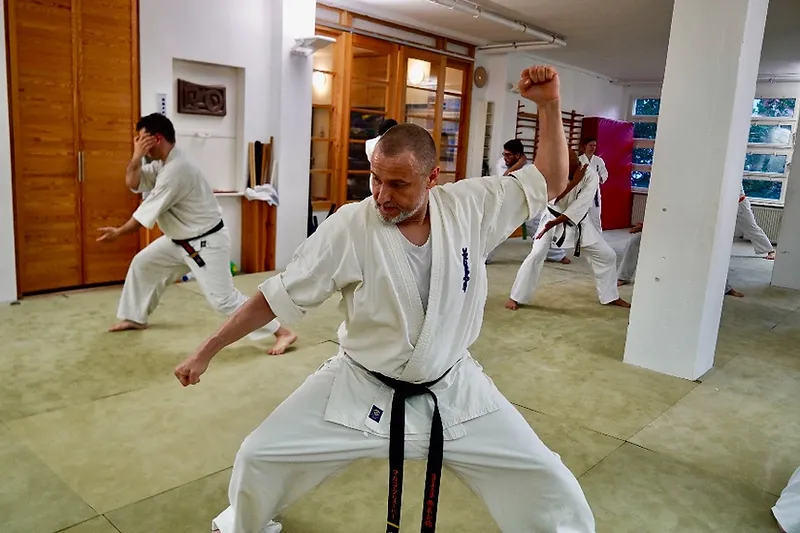
Five styles, one Comparison
Karate is not just Karate. The five major styles, Kyokushin, Shotokan, Goju-Ryu, Shito-Ryu and Wado-Ryu, differ in contact form, stances, kata and philosophy. This comparison helps you to find the right style.
In Shinzen Dojo Berlin we teach Kyokushin, the toughest and most honest style. But we will explain to you honestly which style suits whom.
Every style introduced
Kyokushin
Masutatsu Oyama · 1964"The ultimate truth, no show, no half-measures. Real, tested power."
Shotokan
Gichin Funakoshi · 1938"The way of Karate, character building through constant repetition."
Goju-Ryu
Chojun Miyagi · 1930"Hard and soft, like water that adapts yet breaks rocks."
Shito-Ryu
Kenwa Mabuni · 1928"Unification of Okinawan styles, diversity as strength."
Wado-Ryu
Hironori Otsuka · 1934"The way of peace, evade attacks instead of blocking."
Styles in the Table
| Feature | Kyokushin | Shotokan | Goju-Ryu | Shito-Ryu | Wado-Ryu |
|---|---|---|---|---|---|
| Contact form | Full contact to the body | Point contact (stop) | |||
| Protective gear | None | Hand/foot guards | |||
| Stances | Medium high, compact | Deep, long | |||
| Number of kata | ~25 kata | ~26 kata | |||
| Competition | Full-contact kumite | Point-Kumite + kata | |||
| Philosophy | The ultimate truth | Character building | |||
| Starting age | From 5 (children without contact) | From 5 |
Which style suits you?
Only Kyokushin fights with full contact to the body, without protective gear. Honest, direct, demanding.
Learn more Are you looking for clean technique and deep stances?ShotokanShotokan is built on deep stances and aesthetic technique without full-contact fighting.
Learn more Are you looking for close combat and breathing techniques?Goju-RyuGoju-Ryu combines hard and soft techniques with Sanchin breathing and close combat focus.
Learn more Do you want to learn many kata?Shito-RyuShito-Ryu encompasses the largest kata collection of the five styles.
Learn more Do you want to dodge instead of block?Wado-RyuWado-Ryu combines karate with jiu-jitsu, dodging and countering instead of hard blocking.
Learn moreGet to know Kyokushin in training
Anyone who wants to get to know Kyokushin not just by reading about it but in practice can visit the Shinzen Dojo Berlin training sessions. Adults train in Berlin-Schöneberg, children and teenagers in Berlin-Steglitz.
Styles explained
Read more
What is Kyokushin?
The complete guide to full-contact Karate.
Open HubKarate Knowledge Hub
The central knowledge archive, all topics.
Open Martial artsCombat sports compared
Karate vs. Judo, Taekwondo, boxing and more.
Open TechniqueKarate techniques
Stances, strikes, blocks, kicks, the overview.
Open PhilosophyPhilosophy & Values
The soul of Karate beyond technique.
Open GradingThe belt system
From white to black belt.
Open