Karate- Techniques
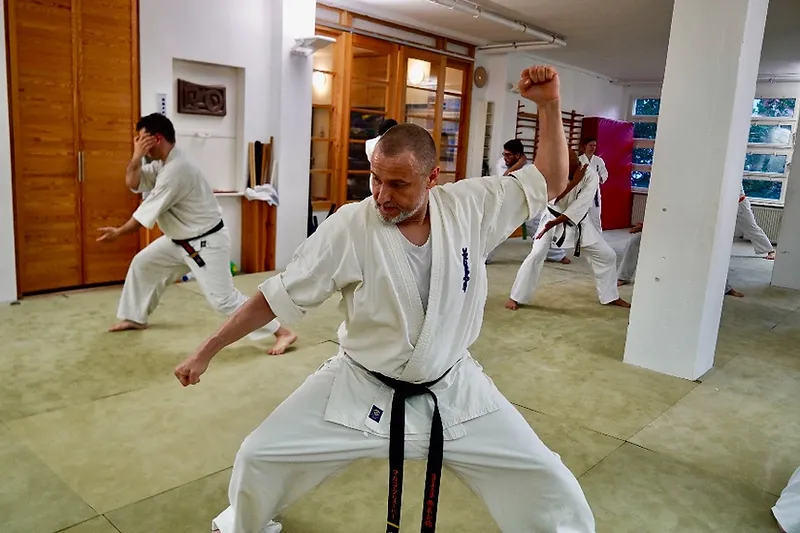
Kihon, Kata, Kumite
Karate training rests on three pillars: Kihon (basic techniques), Kata (forms) and Kumite (partner sparring). If you cannot stand in your stance, you cannot fight, which is why everything starts with Kihon.
This page explains all technique categories with their most important representatives: Dachi (stances), Tsuki (punches), Uke (blocks), Geri (kicks) and Uchi (strikes).
Stances
Stances (dachi) give every technique the necessary support. If you cannot stand in your stance, you cannot fight.
Zenkutsu-Dachi
Forward stanceOne foot in front, 70% weight on the front leg. The most common stance, provides support and reach for every technique.
Kiba-Dachi
Horse stanceWide-legged, deep stance as if sitting on a horse. Stable for side techniques and side kicks.
Sanchin-Dachi
Three-battle stanceNarrow, powerful stance with tension. Core of Sanchin training, trains standing power and stability.
Kokutsu-Dachi
Back stanceWeight on the rear leg, front foot slightly turned. Ideal for defensive and dodging techniques.
Musubi-Dachi
Attention stanceHeels together, feet open. Starting stance for bowing (rei).
Heisoku-Dachi
Formal attention stanceFeet together, straight. Disciplined basic stance for kihon from a standing position.
Punches
Straight punches (tsuki) are the classic attacking techniques. Cleanly repeated until they are solid.
Oizuki
Lunge punchStraight punch with the side standing in front, rear foot follows. The classic attack in kihon.
Gyakuzuki
Reverse punchPunch with the rear side — more powerful than oizuki because the hip rotates with it.
Morotzuki
Double punchBoth fists punch simultaneously — one in front, one as preparation at the hip.
Kizamizuki
JabFast, short punch with the front-standing fist. Less power, much speed — important in kumite.
Tate-Zuki
Vertical punchPunch with a vertical fist position. Faster than the horizontal punch, often used in close combat.
Jun-Zuki
Lunge punchPunch and leg on the same side in front — fluid and dynamic.
Blocking techniques
Blocks (uke) deflect attacks. In Kyokushin, there is less blocking than dodging, but clean blocks are the foundation.
Age-Uke
Upward blockForearm from bottom to top — protects the head (jodan) from attacks from above.
Soto-Uke
Outside blockBlock from outside to inside — deflects attacks to chudan (mid-level).
Uchi-Uke
Inside blockBlock from inside to outside — the counter-movement to soto-uke.
Gedan-Barai
Downward blockDeflection from high to low — deflects attacks to gedan (lower level).
Shuto-Uke
Knife-hand blockBlock with the little-finger edge — elegant and effective, often in the back stance.
Te-Osae
Hand pressPressing defense that controls the attack instead of deflecting it hard.
Kicking techniques
Kicks (geri) are the most powerful techniques in Kyokushin. From straight forward kicks to spinning kicks.
Mae-Geri
Front kickStraight kick forward with the ball of the foot. The most fundamental and important kicking technique.
Mawashi-Geri
Roundhouse kickKick in a semicircular motion — strikes with the instep or the ball of the foot. The classic Kyokushin kick.
Yoko-Geri
Side kickStraight kick to the side — strikes with the edge of the foot (sokuto) or heel. Powerful and penetrating.
Ushiro-Geri
Back kickKick to the rear — one of the most powerful techniques in Kyokushin. Strikes with the heel.
Kansetsu-Geri
Joint kickKick to the knee joint — permitted and effective in Kyokushin. Impact with the edge of the foot.
Kakato-Geri
Heel kickKick from top to bottom with the heel — powerful and executed from a rotation.
Punching techniques
Strikes (Uchi) are short, hard techniques: elbow, backfist, knife-hand. Important in close combat.
Uraken-Uchi
Backfist strikeStrike with the back of the fist — fast and from a rotation. Often used in kumite.
Shuto-Uchi
Knife-hand strikeStrike with the edge of the hand — to the neck or temple. Precise and dangerous.
Hiji-Ate
Elbow strikeStrike with the elbow — one of the most powerful close combat techniques. Possible in all directions.
Empi-Uchi
Elbow thrustThrusting elbow strike — horizontal, vertical or circular. Close combat weapon.
Haishu-Uchi
Backhand strikeStrike with the back of the hand — soft and fast, often used as a preparatory technique.
Nukite
Spear handFingertip thrust — to sensitive areas (throat, solar plexus). Requires years of training.
Kihon-Checklist
Tick off what you have already learned. The checklist shows your progress from beginner to advanced, and what comes next.
Technical progress
Get to know Kyokushin in training
Anyone who wants to get to know Kyokushin not just by reading about it but in practice can visit the Shinzen Dojo Berlin training sessions. Adults train in Berlin-Schöneberg, children and teenagers in Berlin-Steglitz.
Techniques explained
Read more
Examination regulations
All techniques per belt grade in detail.
Open Central pageWhat is Kyokushin?
Kihon, Kata, Kumite, the three pillars explained.
Open LexiconKarate Glossary
All Japanese technical terms translated.
Open GradingThe belt system
Which techniques for which belt.
Open HubKarate Knowledge Hub
The central knowledge archive.
Open PracticeTraining times
When and where you can practise.
Open