
5 Japanese terms that are often misunderstood in Karate – and why they are important

In the world of Kyokushin Karate great importance is placed on tradition, respect, and discipline. But did you know that many Japanese terms we use regularly are often misunderstood? Terms like 'Rei' or 'Dojo' seem simple, but their deeper meaning only unfolds when you engage with them intensively. In this article, we highlight five commonly misunderstood terms and explain why it is important to understand their true meaning.
Let yourself be inspired by wisdom that can enrich not only your karate but also your daily life.
1. Rei (礼): More than just a bow
True meaning: Respect
Misconception: Bowing
'Karate begins and ends with respect.' This famous quote by Gichin Funakoshi, the founder of modern karate, perfectly summarizes the essence of 'Rei'. Often, Rei is reduced to the physical act of bowing, but in fact, it stands for respect, courtesy, and manners. The deeper meaning of bowing in Karate lies in showing respect not only to others but also to the dojo, the traditions, and oneself.


Why is this important?
Respect forms the foundation for every relationship – be it in the dojo or in everyday life. The conscious practice of Rei promotes humility, discipline, and community spirit.
2. Sensei (先生): The guide in life
True meaning: Someone who has gone the path before
Misconception: Karate teacher
The term 'Sensei' is composed of 'Sen' (before) and 'Sei' (life). A Sensei is not just a coach who teaches techniques, but a mentor who accompanies his student on the path of life.


As Sosai Mas Oyama, der Gründer des Kyokushin Karate, sagte:
'A Sensei shows you the way, but you must walk it yourself.'
Why is this important?
A true Sensei inspires you not only in training but encourages you to develop your best skills outside the dojo as well – be it through mental strength or ethical action.
3. Dojo (道場): The place of the path
True meaning: Place of the path
Misconception: Karate studio
A dojo is not just a physical space, but a spiritual place where the journey on the 'path' (Do) begins. It can be a basement, a gym, or a professional studio – what counts is the atmosphere created by the community and the values.
'The dojo is a place where body and mind are shaped,'
said Shigeru Egami, a pioneer of modern karate.


Why is this important?
When you view the dojo as a sacred space, you enter training with more mindfulness and respect the traditions passed on there.
4. Uke (受け): The principle of receiving
True meaning: Receiving
Misconception: Blocking
In Western karate, 'Uke' is often interpreted as blocking. But the original term 'ukeru' means 'to receive'. This subtle but decisive distinction shows that karate is less about pure defense and more about the integration and redirection of energy.
'Receive the attack like water flowing around a rock,'
teaches us Morihei Ueshiba, the founder of Aikido.


Why is this important?
By learning to receive energy instead of blocking it with force, you develop suppleness and effectiveness in your technique – an advantage, especially against stronger opponents.
5. Geri (蹴り): Beware of misunderstandings
True meaning: Kick
Misconception: Diarrhea
The Japanese language can be humorous – 'Geri' means 'kick' in one context, but 'diarrhea' in another. The correct term is 'Keri', which is supplemented by prefixes like 'Mae-' (forward) or 'Mawashi-' (circling).

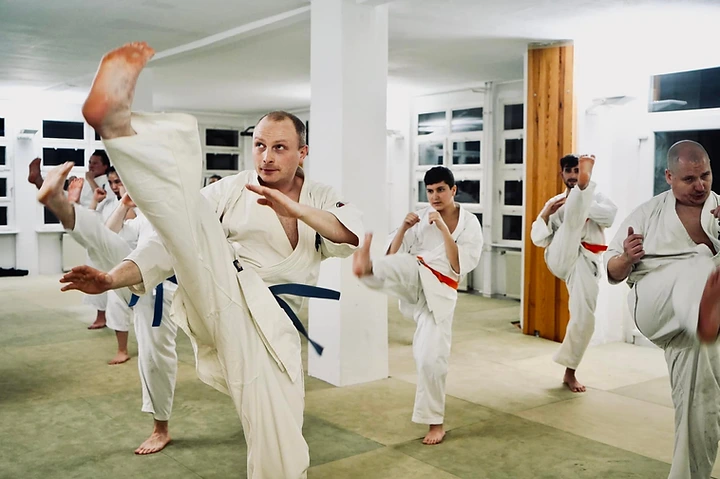
A common beginner mistake is using terms without context. This shows the importance of accuracy and respect for the language and culture.
Why is this important?
The correct use of terms underscores your seriousness and commitment to the martial art. It shows that you treat the traditions with care and respect.
The Shinzen Dojo Berlin – a place for tradition and growth
In Shinzen Dojo Berlin we place great importance on teaching not only the physical aspects of Kyokushin Karate but also on conveying the cultural and linguistic nuances. Because karate is more than a sport – it is a way of life that promotes respect, discipline, and spiritual growth.


The correct application and understanding of these terms are not only essential for your development in karate but also for personal growth. Here at Shinzen Dojo Berlin, we help you internalize these values and integrate them into your life.
'Karate-do is a path that begins with an empty hand but leads to a rich spirit.' – Gichin Funakoshi
Train with us and discover how these profound principles can enrich your karate and your life.


